
Deerfield and Roundabout Railway
An educational demonstration steam powered 7 and 1/2 inch gauge railway operated by the
Lake Forest Live Steamers Railway Museum Incorporated.
(Always scroll down to view complete page.)
The two images below show the Chester crossing target signal after its installation on May 17, 2014. The signal is located next to and protects the crossing of the interchange track (first track on the left) and the Chester main track (third track from the left). The two aspects displayed by the signal are target vertical or target horizontal, and its operation is similar to that of a semaphore signal except the signal target is pivoted at the center instead of at the end. The signal is referred to as a target signal to distinguish it from a conventional semaphore signal. The target is painted the same on both sides with the red and white scheme shown. The Chester crossing target signal governs trains and engines approaching the crossing from all four directions. This is unlike a conventional semaphore signal that governs the movement of trains and engines on one track moving in one direction toward the signal. The Chester crossing target signal is similar in principle to other railway crossing protection schemes that make use of swing gates, ball signals, etc., etc.
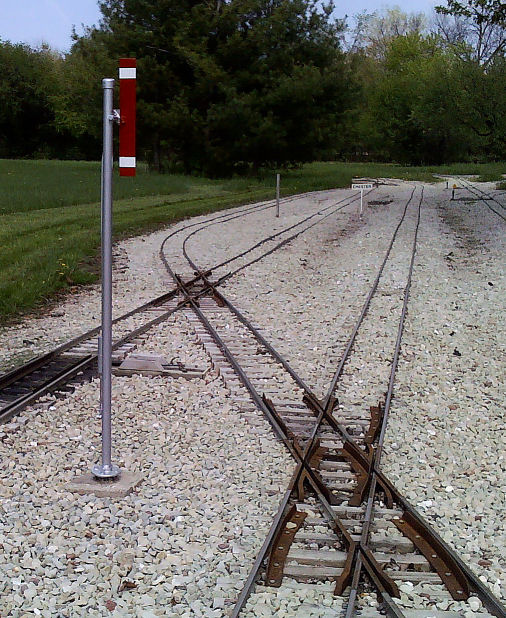
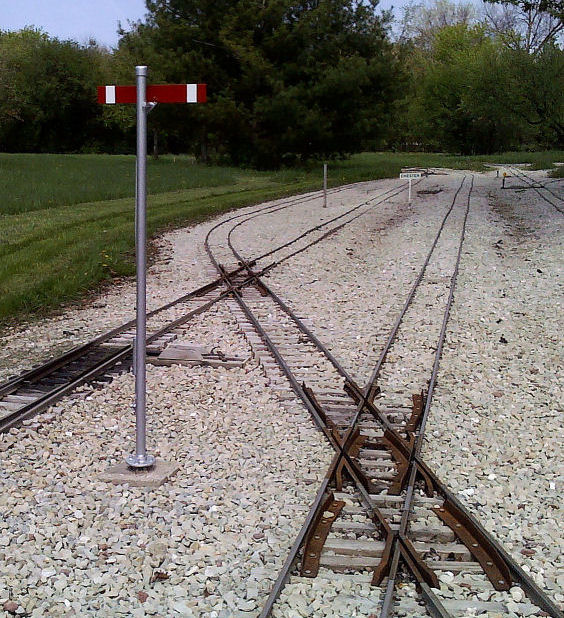
The rules and special instructions hereafter presented in italics type are for educational purposes only and are superseded by the latest published Deerfield and Roundabout Railway rules and special instructions inconsistent therewith.
The following applies to the Chester crossing signal:
TRACKS OR STATIONS NOT SHOWN AS STATIONS IN TIME TABLE
Chester:
Railway crossing at grade;
Crossing of interchange track located 36 actual feet east of the west switch of Chester siding;
Not interlocked;
Target signal governs all directions;
See Rule 98 and Special Instructions X26, X27 and X28 and Actual Track Layout Drawing.
Rule 98. Trains must stop before the end of double or three or more tracks, junctions, railway crossings, and drawbridges, unless signals indicate proceed, or, where proceed signals can not be displayed, the switches are properly lined and it has been ascertained that it is safe to proceed. See Rule 15(m).
Special Instruction X26. The Chester crossing signal aspects indicate the following:
Target vertical indicates movements on Chester main track have right of way and may proceed over the crossing.
Target horizontal indicates movements on interchange track have right of way and may proceed over the crossing.
Special Instruction X27. The position of the Chester crossing signal target must not be changed unless it has been ascertained that no conflicting movement is approaching the crossing.
Special Instruction X28. The normal position of the Chester crossing signal is target vertical and must be restored to normal position as soon as possible after a movement on the interchange track is clear of the crossing.
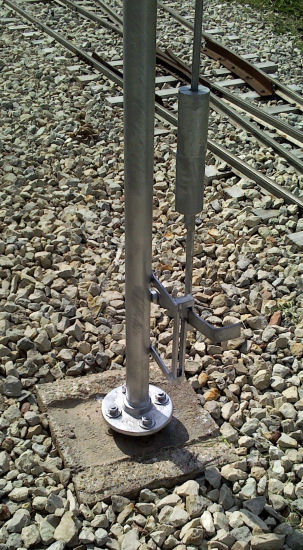
The image below shows the lever actuating mechanism used by DRRY personnel to change and maintain the position or aspect of the target.
DRRY images recorded by J. G. Hook, May 18, 2014.
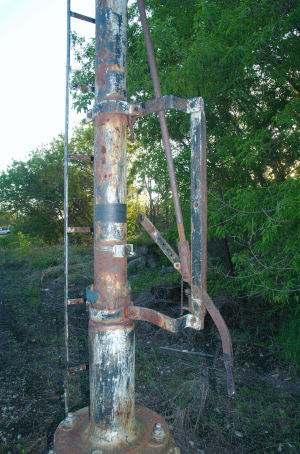
The two images below show the target signal located at Foss station at Bay City, Michigan. The DRRY Chester crossing signal was patterned after this signal. The crossing and other trackage at Foss station was originally part of the former Chesapeake and Ohio Railroad, Detroit & Mackinac Railway or New York Central Railroad. The trackage configuration at this location has changed over the years and at one time the crossing included a single slip.
Foss crossing signal images recorded by Brian Barnt on May 25, 2014.
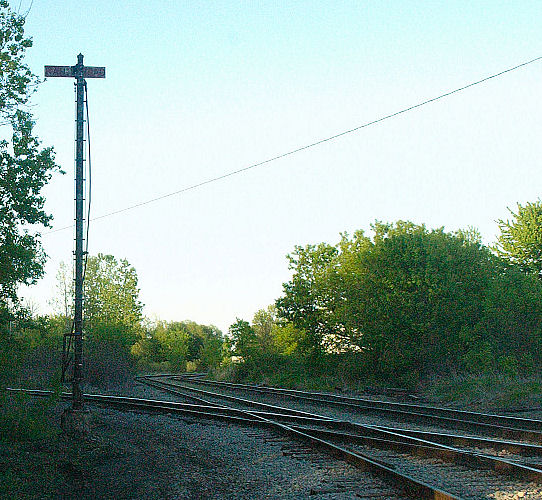
The track running from the lower right corner of the image and over the crossing is former New York Central track. The track running to the upper right of and parallel to the former NYC track is former Chesapeake and Ohio track. The track running from the left side of the image is former Detroit & Mackinac Railway track and after crossing the former NYC connects with the former C&O via a turnout beyond the right side of the image.
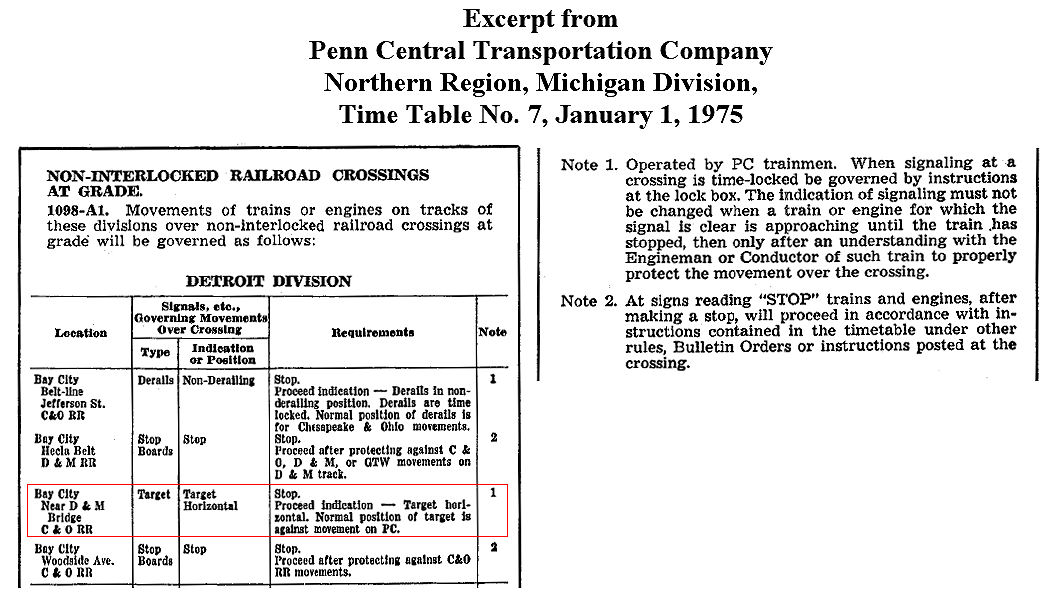
The time table special instructions outlined in red below governed Penn Central (PC) trains or engines at the crossing shown above. Penn Central Transportation Company being the successor to the New York Central Railroad.
For vintage images and a detailed history of Foss station and its trackage see the following link: